Viking grill repair
Viking Grill Repair, Season by Season
An outdoor Viking grill spends the whole year on the patio — through sticky summers, frozen winters and soggy springs — and most of its trouble starts with that weather. Naperville Kitchen Repair Co. brings these grills back to an even, steady flame for patios across our seven-town area, whether the problem is a burner that won't ignite or a rotisserie that sits still.
Rated 4.9 out of 5 by 231 reviewers Reviews
On this page · 5 sections
Gas safety
Smell gas near the grill? Step away first.
Don't light it, don't turn any knobs and leave the tank and its valve untouched. Walk away from the grill; if the odor has drifted indoors, leave the home and bring everyone with you. From well clear of the smell, dial 911 or the gas company, and only then us. A leaking fitting is technician work, never a test-it-yourself project.
- No lighting, no knobs, no valves — hands off the whole grill
- Gather kids and pets at a distance; leave the house too if the odor is inside
- Make the emergency call from outside, upwind and clear of the smell
- Ring us once responders say the yard is safe again
Burner 1 of 3 · quick answer
What stops a Viking outdoor grill burner from lighting?
Either the spark isn't reaching the gas or the gas isn't reaching the burner. A cracked, wet or misaligned igniter electrode, a failing igniter module, ports caked with grease, or a burner tube blocked by a spider nest are the usual reasons. If one burner lights and its neighbor doesn't, the fault lives at that one burner.
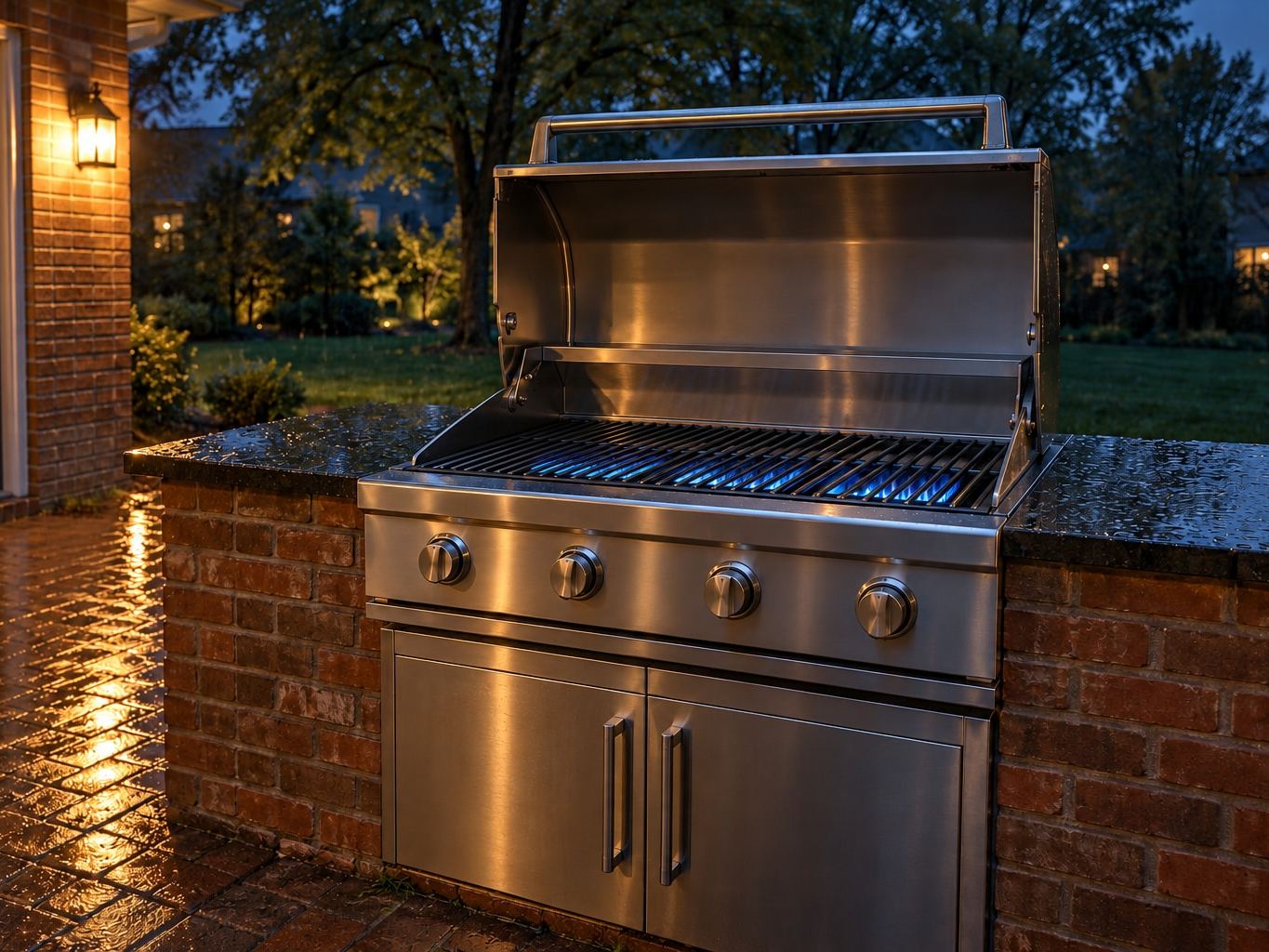
Signs your grill needs more than a scrub
- The igniter clicks away, but one or more burners never catch
- An electrode that is cracked, dirty or bent away from the burner, or plugged ports right at that spot
- One side chars while the other barely browns
- Clogged burner ports, or a burner tube partly blocked or rusted through
- A gas odor around the hose, the valves or the fittings
- A loose, worn or damaged connection — hands off, and follow the gas warning that opens this page
- The rotisserie spit stops, or turns in jerks
- A weakening rotisserie motor, or grease gumming up the spit and its bracket
- Rust flaking inside the firebox or beneath the grates
- Moisture that sat through winter; rust on burners and heat shields needs treatment before it eats holes
Fix the old grill or buy a new one?
There's no single rule, and we won't talk you into a repair that doesn't make sense. These are the things that tip the decision.
Repair usually wins when
- The body and firebox are solid, with surface rust only
- The trouble is in replaceable parts: burners, igniters, valves, the rotisserie motor
- It cooks the way you want and suits your outdoor kitchen
- Replacement parts for that model are still out there
Replacing may be smarter when
- Rust has gone through the firebox or the frame
- Several major parts have failed together
- Parts for an older model can no longer be found
- The gas system needs so much work that a new grill is the better buy
Once we've looked it over, you'll hear honestly which column your grill falls into — and when fixing it is worthwhile, the estimate is on paper before any part comes off. Our pricing page explains what pushes a repair up or down.
Burner 2 of 3 · quick answer
Is it worth repairing an old Viking grill, or should I replace it?
If the firebox and frame are sound, repair usually makes more sense — burners, igniters, valves and rotisserie motors can all be replaced. When rust has eaten through the body, several major parts fail at once, or parts can't be found anymore, a new grill may be wiser. One inspection settles which case you're in.
A grill's year, from fall cover-up to spring repair
Grills here sit through real Illinois winters, so their care follows the calendar. When the spring check turns up a problem, the repair visit picks up where the season left off.
Late fall
The last cookout, a hot burn-off to loosen grease, a cleaning, the gas supply closed for storage and a fitted cover pulled on.
Winter
Covered and idle for months. Snow and repeated freeze-thaw are hard on fittings, while insects and small animals hunt for shelter inside burner tubes.
Early spring
Cover off, then a look for nests, rust and chewed hoses before the first light. If anything seems off, call before you light it.
The repair visit
We inspect the whole grill: supply line and fittings, burner tubes and ports, igniters, valves and the rotisserie.
Before any work
We walk you through the findings and hand over a written estimate; whatever you paid for the visit ($89) comes off the repair total.
Repair and relight
Burner tubes, igniters, fittings or the rotisserie motor get replaced, rust gets cleaned and treated, then each burner gets fired and every cooking zone is checked for an even flame before we leave.
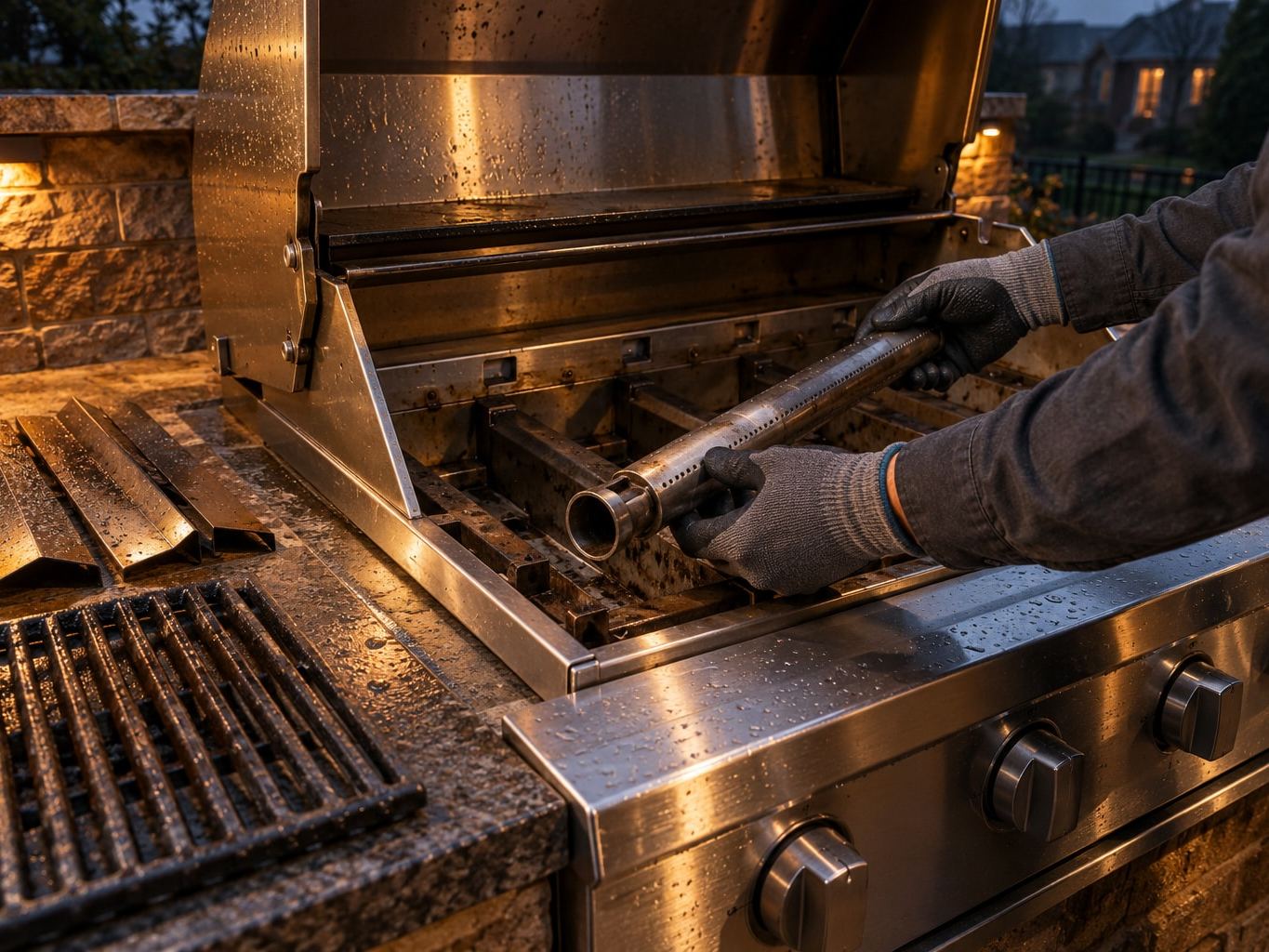
Winter prep the grill will thank you for
This is ordinary seasonal storage — nothing like the emergency described in the warning above.
- Do a short burn-off — every burner up full, lid closed — then let the grill cool completely.
- Brush the grates; empty and scrape the grease cup and the tray beneath the burners.
- Wipe the stainless surfaces dry so water doesn't sit on them through the cold months.
- Shut the propane cylinder or the natural gas line to the grill, following your manual's instructions for seasonal storage.
- If you run on propane, disconnect the tank and keep it outdoors, upright — never in the garage or the house.
- Pull on a breathable cover that fits snugly and reaches close to the ground.
- Come spring, check the burner tubes for nests and the hose for cracks before the first light — or book us to do it alongside any indoor Viking range work.
Burner 3 of 3 · quick answer
What causes hot and cold spots on a Viking grill?
Uneven heat nearly always traces back to the burners. Ports clogged with grease, rust or debris starve part of the flame, and a burner tube blocked by a nest or partly rusted through can't spread gas evenly. Cleaning the ports sometimes solves it; a damaged burner tube has to be replaced.
Questions from backyard cooks
- Do you fix the Viking rotisserie too?
- Yes. When the spit stops turning we check the motor, the spit and its supports. A dead motor gets replaced; a spit that binds is cleaned and realigned so it turns smoothly under a full load.
- Is same-day grill repair possible in spring and summer?
- Yes, when a slot is free that day, so ring early. We take calls 24/7; house calls happen 8 AM–6 PM daily. If there's any hint of gas in the air, follow the warning at the top of this page first.
- What should I mention when I call about my grill?
- Which burners act up, the fuel (propane cylinder or a natural gas line), how long it stood idle, and anything you noticed — clicking, uneven flames, rust. A snapshot of the model label, if you can spot it, lets us pack suitable parts. Phone, booking and the rest are listed on our contact page.
- How should I put my Viking grill away for the winter?
- Burn off residue, let the grill cool, then brush the grates and wipe the burners and drip tray. Close the propane cylinder valve or the natural gas shutoff, and cover the grill only once it is completely dry. Before the first spring cookout, look for spider webs or nests in the burner tubes; a blocked tube is a common reason for a weak or uneven flame.
Ready for a steady flame again?
Dial (872) 268-8090 or grab an online slot. Phones stay staffed 24/7; grill visits run 8 AM–6 PM daily.
$89 per visit, not per appliance; approve the fix and that trip charge melts into the repair price instead of sitting on top of it.