Built-in, freestanding, French door
Viking Refrigerator Repair, Readings Before Verdicts
A Viking refrigerator that hums along while the milk turns warm can have half a dozen different causes. Our technician reads the actual temperatures first, then works through the compressor, the fans and the sealed cooling system, and only the culprit gets swapped out.
Rated 4.9 out of 5 by 231 reviewers Reviews
On this page · 7 sections
Warm shelves, soft ice cream, a silent ice maker
Each sign points toward a handful of components. The more precisely you describe it, the faster the diagnosis goes.
- The fresh-food side feels barely cool, though the unit sounds like it is running
- Dust-clogged condenser coils, a stalled condenser or evaporator fan, a faulty temperature sensor, or a problem in the sealed refrigerant system
- Ice cream is soft and frozen foods are thawing at the edges
- Frost choking the evaporator after a defrost failure, a freezer fan that has quit, or a door gasket letting room air in
- The ice maker has gone quiet and the bin stays empty
- A frozen or kinked supply line, a failed water inlet valve, a jammed ice maker module, or a freezer running too warm to make ice
- Water pools under the crisper drawers or seeps out onto the floor
- Defrost water backing up behind an ice plug, a split pan under the unit, or a weeping fitting on the ice maker supply
- A new buzz, rattle, or clicking that was not there before
- A fan blade striking ice, a fan motor with tired bearings, or a compressor laboring through each start
Burner 1 of 3 · quick answer
Why is my Viking refrigerator running but not cold?
A motor that hums while the shelves stay warm means heat is trapped inside the box. The usual causes are dirty condenser coils, a fan that has stopped moving air, a faulty temperature sensor or control, or low refrigerant from a leak in the sealed loop. A technician measures temperatures and tests each part to find which one.
Why running is not the same as cooling
Think of a fridge as a heat pump pointed at your groceries. Warmth is soaked up by the evaporator inside, carried off by the compressor, and dumped into the room through the condenser coils. A fan moves air across each end of that loop. If any link slows down, the compressor can run nonstop and the cabinet still warms up.
So one complaint can hide several very different repairs behind it. Coils matted with dust and pet hair cannot shed heat, so cleaning them can restore cooling. A seized evaporator fan leaves cold air trapped behind the back panel of the freezer. A sensor that misreports the temperature tells the control everything is fine when it is not. Escaping refrigerant from the sealed loop leaves the charge low, which is a bigger job and changes the repair conversation.
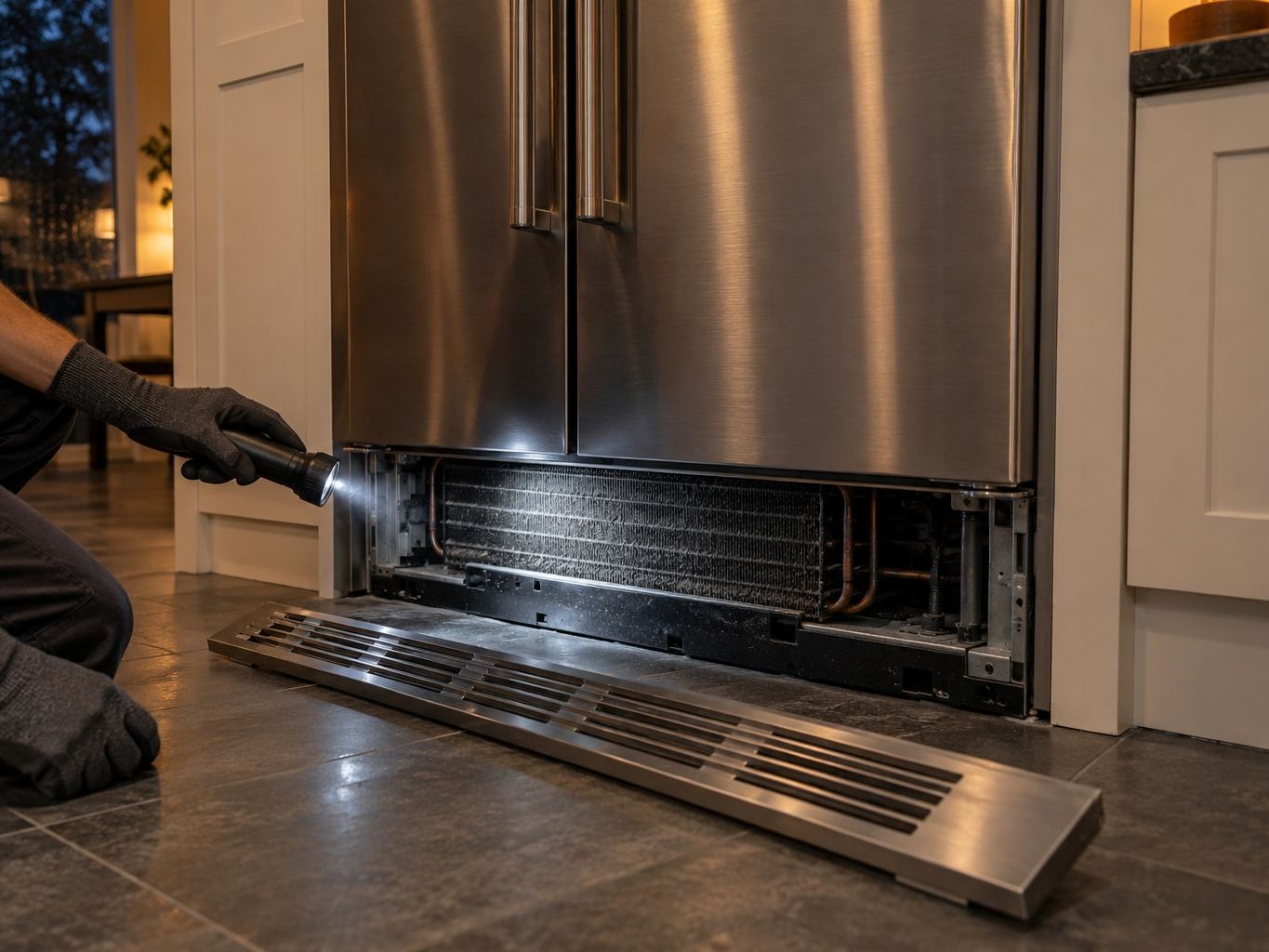
Built-in Viking units typically hide the condenser behind a kick grille or a top louver, and reaching it takes some clear floor space. On freestanding and French door units, the back of the cabinet often comes into play too. Either way, the visit starts with thermometers in both compartments and a watch on the on-off rhythm before any part is condemned.
Until the technician rings the bell
A few small steps protect your food and make the diagnosis smoother.
- Open the doors only when you truly must, so stored cold lasts longer
- Move the most perishable items, like milk, meat and medicine, into a cooler with ice
- Pull jars and boxes an inch away from the rear vents in both sections
- Keep the base grille of a built-in model clear of rugs, shopping bags and step stools
- Look at the circuit breaker in case the unit lost power briefly and partly
- Clear a path to the refrigerator so the technician can pull the grille and reach the coils
- Write down any temperatures or messages shown on the display
Burner 2 of 3 · quick answer
What stops a Viking refrigerator ice maker from making ice?
An ice maker stops when water cannot reach it or the freezer is too warm to freeze it. Common causes are a frozen or pinched supply line, a failed water inlet valve, a jammed ice maker module, or a freezer section running too warm. The technician checks water flow and freezer temperature before replacing the module.
What a refrigerator visit looks like
First
Temperatures are read in the fresh-food and freezer sections, and the technician watches how the compressor and fans are cycling.
Next
Next come the compressor, both fans, the defrost circuit and the sealed loop, tested one after another until the weak link shows itself.
Then
You hear what failed and your options, with a written price for each one. Nothing proceeds until you choose; the $89 trip charge is absorbed into whichever fix you pick.
During the repair
Parts are replaced with OEM-compatible components that meet the original specifications, and the unit is run while the technician watches temperatures start to fall.
Before leaving
You get practical care advice for your model, such as keeping coils clear and checking the door gaskets, so the same failure is less likely to return.
Sounds and signs, decoded
Some noise is normal for any refrigerator. What matters is a sound that is new, louder, or paired with poor cooling.
| What you hear or see | What usually sits behind it |
|---|---|
| Steady low hum while cooling | Normal compressor operation |
| Loud buzz, or a buzz followed by a click and silence | A compressor struggling to start, or its start relay |
| Ticking or scraping from the freezer | A fan blade brushing against built-up ice |
| Rattle from the bottom of the unit | A drain pan that has shifted, or a wobbling condenser fan |
| Gurgling or dripping inside the cabinet | Refrigerant flow, or water headed for a blocked drain |
| Frost spreading across the freezer back wall | A defrost heater, sensor or timer that has quit |
Burner 3 of 3 · quick answer
What does a buzzing Viking refrigerator mean?
A soft hum is normal. A loud buzz, especially one that cuts off with a click, often means the compressor is struggling to start or its start relay is failing. Buzzing from the freezer can also be a fan brushing against ice. If the sound is new or cooling has dropped, book a check.
Refrigerator questions from our neighbors
- How long should a Viking refrigerator last?
- It depends heavily on care and on how the unit was installed. Clean condenser coils, sound door gaskets and good airflow around a built-in model all extend its life. And if fixing yours would be money poorly spent, you will hear that directly.
- Is it worth repairing my Viking fridge, or should I replace it?
- Many failures, such as fans, sensors, valves and drains, are well worth fixing on a built-in Viking. Sealed-loop problems call for weighing the overall condition of the unit. The cause and a written figure come first, and the decision stays yours.
- Why would the freezer stay frozen while the fridge side warms up?
- Often that cold air is not reaching the fresh-food section. Ice build-up on the evaporator, a stalled fan, or a damper that is stuck closed are common reasons. Most often it is an airflow or defrost fault, not a failed compressor.
- Is a refrigerator that stopped cooling an emergency?
- It can be, because food is at stake. Call us any time, day or night, and see the emergency repair page on urgent calls. Keep the doors closed and use a cooler with ice for the most perishable items while you wait.
- Can cleaning the coils really make a difference?
- Yes. A blanket of dust traps heat at the coils, so the compressor runs longer and cooling suffers along with the power bill. Our article on Viking energy efficiency covers simple upkeep, and during the visit you will be shown where the coils sit on your model.
- Why does the water dispenser on my Viking refrigerator run slowly?
- Start with the water filter: an old one is the simplest cause, and swapping it follows the steps in your owner's manual. Low water pressure in the house, a line partly frozen inside the door, or a failing inlet valve can do the same thing. If a fresh filter changes nothing, the technician checks the valve and the line.
What decides whether it is fixed on the first visit
What moves the repair price
We publish no repair prices here; the real figure follows the diagnosis. The points below drive both the bill and the schedule.
- Which part failed
- Fans, sensors, inlet valves and drain issues are often straightforward. Sealed-system work on the refrigerant side is a larger job.
- Whether the part is in hand
- Common components may be available right away; anything special-ordered brings the technician back for a second appointment.
- Access to the unit
- Built-in refrigerators with custom panels take more care to open up and reach than freestanding models.
- Frost and ice build-up
- A heavily iced evaporator has to thaw before some tests are possible, which can split the job across two visits.
- More than one fault
- A failed fan can stress the compressor; finding both at once changes the plan and the written price.
Get the cold back where it belongs
Describe what the fridge or freezer is doing and when it began. One $89 visit covers the diagnosis, and a written price waits for your yes before parts change.
$89 per visit, not per appliance; approve the fix and that trip charge melts into the repair price instead of sitting on top of it.