Viking hood repair
Viking Hood Repair: Testing the Draft You Can't See
A Viking hood can roar on its top setting and still leave smoke hanging over the burners. We measure what the fan actually pulls — on every speed — and trace the motor, wiring and duct behind it, because a noisy hood isn't necessarily a strong one.
Rated 4.9 out of 5 by 231 reviewers Reviews
On this page · 6 sections
Why a serious cooktop needs a hood that works
Viking burners are built for hard searing and fast stir-frying, and that kind of cooking throws a lot into the air: grease mist, smoke, steam and the smell of whatever hit the pan. A healthy hood carries all of it outdoors. A struggling one lets it settle — as a tacky film on cabinet doors and the ceiling, as fog on the windows, and as last night's salmon greeting you in the family room the next morning.
Grease is the part owners underestimate. Whatever the filters miss collects inside the hood housing and along the duct. Over time it narrows the airway, makes the motor work harder and becomes something you don't want sitting above an open flame. That's why we treat ventilation as part of keeping the whole cooking zone safe, not just pleasant. When the burners themselves misbehave, our Viking cooktop repair and Viking range repair pages pick up the story.
Kitchens around Naperville keep getting bigger and more open to the living space, and in an open plan a weak hood shows everywhere at once. We wrote about that shift in what we're seeing in local kitchens.
Burner 1 of 3 · quick answer
Why is my Viking range hood fan not working?
A dead fan starts with the electrical panel: make sure the hood's breaker hasn't tripped. If the hood light still comes on, power is reaching the hood and the trouble sits in the fan circuit: a failed switch or control, a loose connection, or a motor that has seized. A technician tests each of those in turn rather than guessing at a part.
When the hood stops pulling its weight
- You press the fan button and nothing happens
- A switch or control fault, a connection shaken loose over time, or a seized motor
- The fan spins, yet smoke still drifts across the room
- Grease-packed filters or duct, a backdraft damper stuck shut, or a motor turning slower than it was built to
- Rattling, humming or a whistle that wasn't there last year
- Tired motor bearings, grease weighing down one side of the fan wheel, loose mounting screws, or a damper flapping in the duct
- The hood's lamps above the burners stay dark
- Burned-out bulbs, a light switch that has failed, or a bad connection at the socket
Loud is not the same as strong
A hood that sounds powerful can still be moving very little air. This is how a symptom maps to what we inspect first.
| What you notice | Likely cause | What we check first |
|---|---|---|
| Noisy on high, weak at the cooktop | Grease narrowing the duct | Pull at the hood opening on each speed, then the duct run |
| Air moves a little on every speed, never a lot | Backdraft damper stuck partway closed | The damper flap at the hood and at the wall or roof cap |
| Fan slows down or smells hot after a while | A motor on its way out | Motor bearings, how the motor draws power, fan wheel balance |
| Speeds skip, or the fan cuts out mid-cook | Switch, control or wiring fault | Switch contacts, connections and the circuit feeding the hood |
| Smoke spills past the sides of the hood | Clogged filters or too low a speed for the cooking | Filter condition and how the hood captures at each setting |
Burner 2 of 3 · quick answer
Why is my Viking hood so loud?
Noise usually comes from the fan wheel or the motor. Grease on the blades throws the wheel off balance, worn bearings hum or grind, and loose screws rattle. A clogged filter makes the fan strain, and a damper flapping in the duct adds its own racket. Volume that has crept up over months is worth checking before the motor gives out.
Metal filters versus charcoal filters
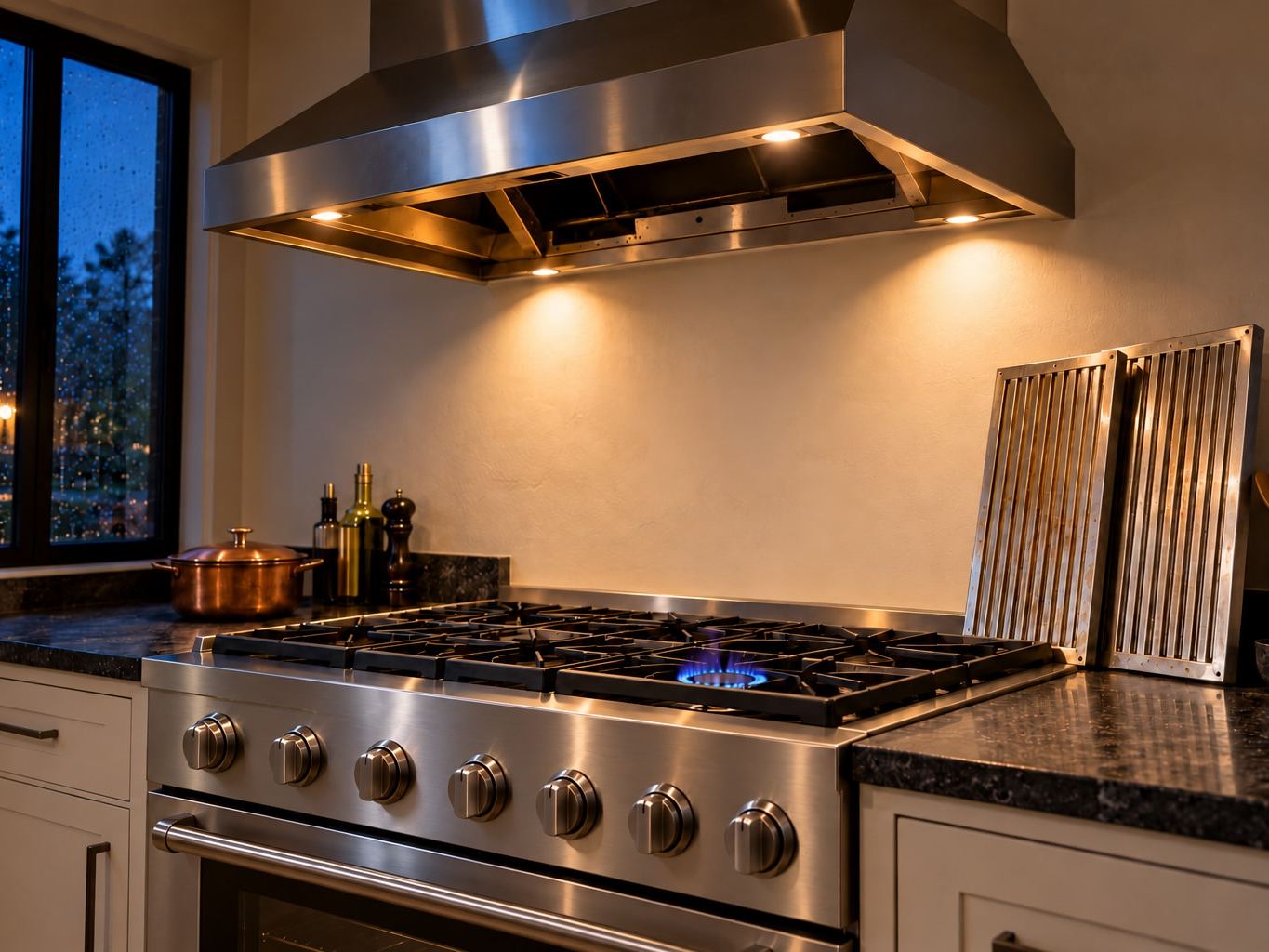
Viking hoods use one of two filter setups, depending on whether the hood vents outdoors or recirculates air back into the kitchen. They're cared for very differently.
Metal filters (mesh or baffle)
- Trap grease on hoods that exhaust outdoors
- Washable by hand, or in the dishwasher if your manual allows it
- A rough guide is every month or two of regular cooking; sooner if you sear or fry often
- Replace only when bent, torn or clogged beyond cleaning
Charcoal filters
- Found on recirculating setups that send air back into the room
- Soak up odors and can't be washed back to life
- Swapped for new ones, commonly every six months to a year
- A recirculating hood with spent charcoal moves air but leaves the smell behind
The manual for your model has the final word on intervals. Not sure which kind you have? The technician will show you during the visit and leave you with a cleaning rhythm that matches how you cook.
How a hood visit unfolds
Arrival
The hood gets switched through each speed, lamps on, and check where the air goes — at the front edge of the cooktop, not just under the filters.
First look inside
Filters come out. We inspect the motor, the fan wheel, the switch wiring and as much of the duct and damper as can be reached from the kitchen.
Before any work
We name the fault in everyday language and write the estimate down. Say yes to the work and the $89 you paid for the visit comes off the total.
The repair
Motor replacement, duct and damper cleaning, new filters, switch or light repair — whatever the diagnosis called for, using OEM-compatible parts.
Before we leave
Every speed gets tested again, and we show you how to remove and clean the filters so the hood keeps its pull. See how our pricing works if you'd like the details first.
Burner 3 of 3 · quick answer
Why is my Viking range hood not pulling smoke?
If the fan runs but smoke lingers, the exhaust path is choked somewhere. The usual culprits are grease clogging the filters or the duct, a backdraft damper stuck closed, or a motor spinning slower than it should. Clean or swap the filters first; if the draw is still weak, the duct and motor need a technician's look.
Hood questions owners bring to us
- Can I clean the inside of my Viking hood myself?
- The filters and the underside of the hood, yes — warm water and a degreaser that's safe on stainless steel. Leave the motor, wiring and duct to a technician: they sit behind panels, need the circuit shut down at the panel, and grease inside the duct can't be reached from the kitchen.
- Should I stop using my Viking cooktop until the hood is fixed?
- Light cooking is generally fine, though smoke and grease will settle around the kitchen. Hold off on high-heat searing or frying until it's fixed, and if the hood itself starts giving off a scorched odor, switch it off and call.
- How do I find out what my hood repair will cost?
- After diagnosis, not before. You pay $89 for the visit, that sum is deducted from the repair, and the estimate is in writing before a screwdriver comes out. Our pricing page explains what makes a repair cost more or less.
- How often should the grease filters in a Viking hood be cleaned?
- It depends on how you cook. Frequent searing, frying or wok cooking loads the filters much faster than simmering, so check them by look and touch rather than by the calendar: a sticky film or grease at the edges means it is time. Your owner's manual says whether your filters can go in the dishwasher.
Hood roaring but not pulling?
Ring (872) 268-8090 — someone picks up 24/7 — or pick a time in the online calendar. House calls happen 8 AM–6 PM daily.
$89 per visit, not per appliance; approve the fix and that trip charge melts into the repair price instead of sitting on top of it.